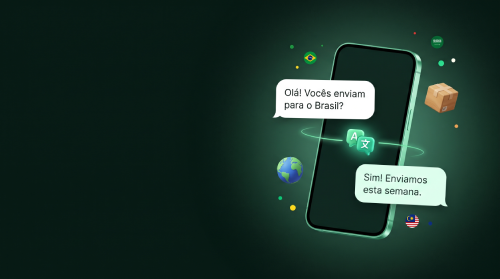
A message comes in at 9:14 pm:
"Olá, vocês enviam para o Brasil? Qual o prazo de entrega?"
You sell furniture out of Jepara, Indonesia. You can guess "Brasil." The rest goes into Google Translate. You type an answer, translate it back, paste it into WhatsApp, and hope it doesn't read like a robot wrote it.
That's fine once. Now picture 40 of those a day, each round trip eating a minute or two, while the buyer in Brazil is also chatting with three other sellers.
This post covers what WhatsApp's built-in translation can do today, what it can't, and the habits that keep cross-language chats turning into orders.
WhatsApp's built-in translation is great for reading
Since September 2025, WhatsApp can translate messages. Long-press a message, tap Translate, pick the languages.
A few details worth knowing:
- On Android, it launched with six languages: English, Spanish, Hindi, Portuguese, Russian and Arabic. Android can also auto-translate an entire chat.
- On iPhone, it covers 19+ languages, because it uses Apple's own translation engine.
- Translation runs on your device, so WhatsApp can't see what gets translated. Nice for privacy.
For understanding what a buyer wants, that's genuinely useful. For selling, there are three gaps:
- Limited languages. Indonesian and Malay weren't on the Android launch list. If your buyers write in Portuguese, you're covered. If your team needs things translated into Indonesian on Android, maybe not.
- It lives on each phone. Five agents means five separate setups, and nobody can see what a teammate already translated.
- It doesn't write your reply. This is the big one.
The reply is the hard half
Understanding the question gets you halfway. The reply is what closes the sale, and that's where copy-paste translation tends to fall apart:
- Tone. A buyer in Saudi Arabia usually expects a courteous, slightly formal opening. A buyer in Brazil is warmer and more casual. Machine translation tends to land somewhere in the flat middle, which feels stiff to both.
- Product terms. "Kayu jati" should become teak, and sometimes doesn't. Local shorthand like "DP" (down payment) means nothing to a buyer in Riyadh.
- Numbers and money. "450rb" is unreadable outside Indonesia. One misunderstanding about whether shipping is included can kill the deal.
- Speed. Every trip to a translation app adds time. In sales chats, the fastest reply usually wins.
6 rules for selling in a language you don't speak
These work with any tool, ours or not.
1. Write short, plain source sentences.
Translation breaks on long sentences full of slang and abbreviations. Instead of "Sis, the 2m one is ready stock ya, can ship asap," write: "The 2-meter table is in stock. We can ship it this week." One idea per sentence.
2. Spell out numbers, currency and units.
"USD 450 per set, shipping not included," not "450 nett." "200 cm," not "2m-ish." Numbers are the most expensive thing to get wrong.
3. Keep a product glossary.
List the 20–30 words you use every day (materials, sizes, finishes, payment terms) and lock in one approved translation for each. Share it with every agent, so buyers don't see three different words for the same thing.
4. Reply in the language they wrote in.
If they wrote in Portuguese, answer in Portuguese, even if your English is better. Buyers can tell you made the effort, and they notice it from the first reply.
5. Mind their clock and their weekend.
Brasília is 10 hours behind Jakarta. Saudi Arabia is 4 hours behind, and its weekend is Friday–Saturday. Malaysia is 1 hour ahead. A follow-up that lands at 3 am their time gets ignored more often than read.
6. Have a human check anything binding.
AI translation is good enough for conversation now. For final prices, contract terms and delivery promises, have someone read it before it goes out. One wrong "included" can cost you real money.
How we handle this in WhatsCRM Hub
We built translation into WhatsCRM Hub because our own users kept running into exactly this, especially the ones selling to Malaysia, the Middle East and Brazil. Here's how it works:
- One-click translation on incoming messages. Every message has a translate icon, and each agent sees it in the language they've chosen. Translations are saved, so when a teammate opens the same chat, it doesn't get translated (or paid for) twice.
- Write your reply in your own language. Agents type in Indonesian (or whatever they're comfortable with) and translate the draft. The system detects the buyer's language from their recent messages, so nobody has to pick a target language.
- Reply suggestions from your own AI agent. The AI reads the last 10 messages and suggests replies based on the documents you trained it on: your price list, SOPs, catalog. The agent picks one, tweaks it, translates, sends. A person still makes the call.
- 21 languages, including English, Malay, Arabic, Portuguese, Japanese, Chinese, Korean, Thai and Vietnamese. Javanese and Sundanese are in there too, for local customers who'd rather chat in their regional language.
- One inbox for every channel: WhatsApp, Instagram, Messenger, Telegram, live chat and email. Translation works the same way across all of them.
The upshot: an agent who only speaks Indonesian can serve a buyer in São Paulo without opening another tab, and the buyer gets answered in Portuguese.
Want to see it? Try the free demo with sample data, or browse the features.
FAQ
Can WhatsApp translate messages automatically?
Yes. Since September 2025 you can long-press a message and tap Translate, and Android can auto-translate a whole chat. Supported languages differ between Android and iPhone.
Can WhatsApp translate my replies into the buyer's language?
The built-in feature focuses on translating messages you receive. To reply in another language, you still write it yourself, use a translation app, or use a CRM that translates drafts.
Is Google Translate good enough for sales chats?
For reading, mostly yes. For replying, you'll get much better results if your source sentences are short, numbers are spelled out, and product terms stay consistent (rules 1–3 above).
Which languages does WhatsCRM Hub support?
21, from Indonesian, English, Malay, Arabic and Portuguese to Japanese, Chinese, Korean, Spanish, French, German, Javanese and Sundanese.